Moments that Change PeopleAwaken PerspectivesReframe MindsetsShape BehaviourInspire ConfidenceUnlock PotentialEnable LeadershipCreate CohesionIgnite MomentumTransform CultureAccelerate PerformanceDrive Growth

Development That Actually Works

How We Work

The challenges we’re asked to help with

Sales Teams

Sales teams are busy, but effort doesn’t always translate into consistent performance.
Conversations default to product or price, leading to unnecessary discounting and lost margin.
Sales performance is driven more by brand strength than sales capability, creating a false sense of effectiveness.
Relationships are relied upon, but often lack depth or differentiation, leaving accounts vulnerable.
Time is spent on lower-value opportunities, limiting commercial impact
Learn More

Leadership and Management

New managers lack confidence or clarity in role, leading to hesitation and inconsistency.
Leaders aren’t clear on what “good” looks like, resulting in inconsistent standards and performance.
Performance issues aren’t addressed consistently, allowing underperformance to persist.
Leaders don’t always recognise the wider impact of their decisions, limiting productivity and commercial outcomes.
People aren’t consistently developed, creating risk around future capability and succession.
Learn More

Culture and Collaboration

Different teams operate in different ways, leading to inconsistency across the organisation.
Collaboration is fractured, with teams operating in silos rather than working towards shared outcomes.
A “not our problem” mindset develops, reducing ownership across teams and functions.
Difficult conversations are avoided or delayed, allowing issues to persist.
Values are defined, but not consistently followed, so expected standards aren’t upheld.
Learn More

The Process We Implement

1. Diagnose what’s really happening

Most organisations come to us with a view of the problem and an idea of the solution. Sometimes they are right. Often, what they describe is only part of the picture.
Our diagnostic process is designed not only to help us understand the business, but to help the client see their challenge more clearly. That often means separating symptoms from root causes, reframing the issue, and identifying the development pathway that will make the biggest difference.
Because a business that believes it needs a day of training may actually need a broader shift in capability, behaviour, leadership, or culture.
Where appropriate, we use structured diagnostic tools, competency frameworks, behavioural analysis and stakeholder input to build a clearer picture of what is really happening.
This stage gives clients clarity on what is really happening, what needs to change, and what kind of development is most likely to create meaningful results.
Diagnosis is not just about customising training.
It is about avoiding the wrong solution.

2. Design what will make the difference

We work in partnership with our clients to shape an approach that reflects their business, their people, and the reality of their challenge.
Following the diagnostic stage, we define the most effective way forward – not just what is possible, but what is needed.
That means being clear on:
This is not about applying a standard solution.
It’s about creating something that fits – in language, in context and in relevance – so that it makes sense to the people involved and can be applied day-to-day.
Our role is to ensure that what is designed is proportionate, relevant, and aligned to the outcomes the business is trying to achieve.
Not every challenge is solved through training – and the wrong solution can do more harm than good.

3. Develop capability and confidence

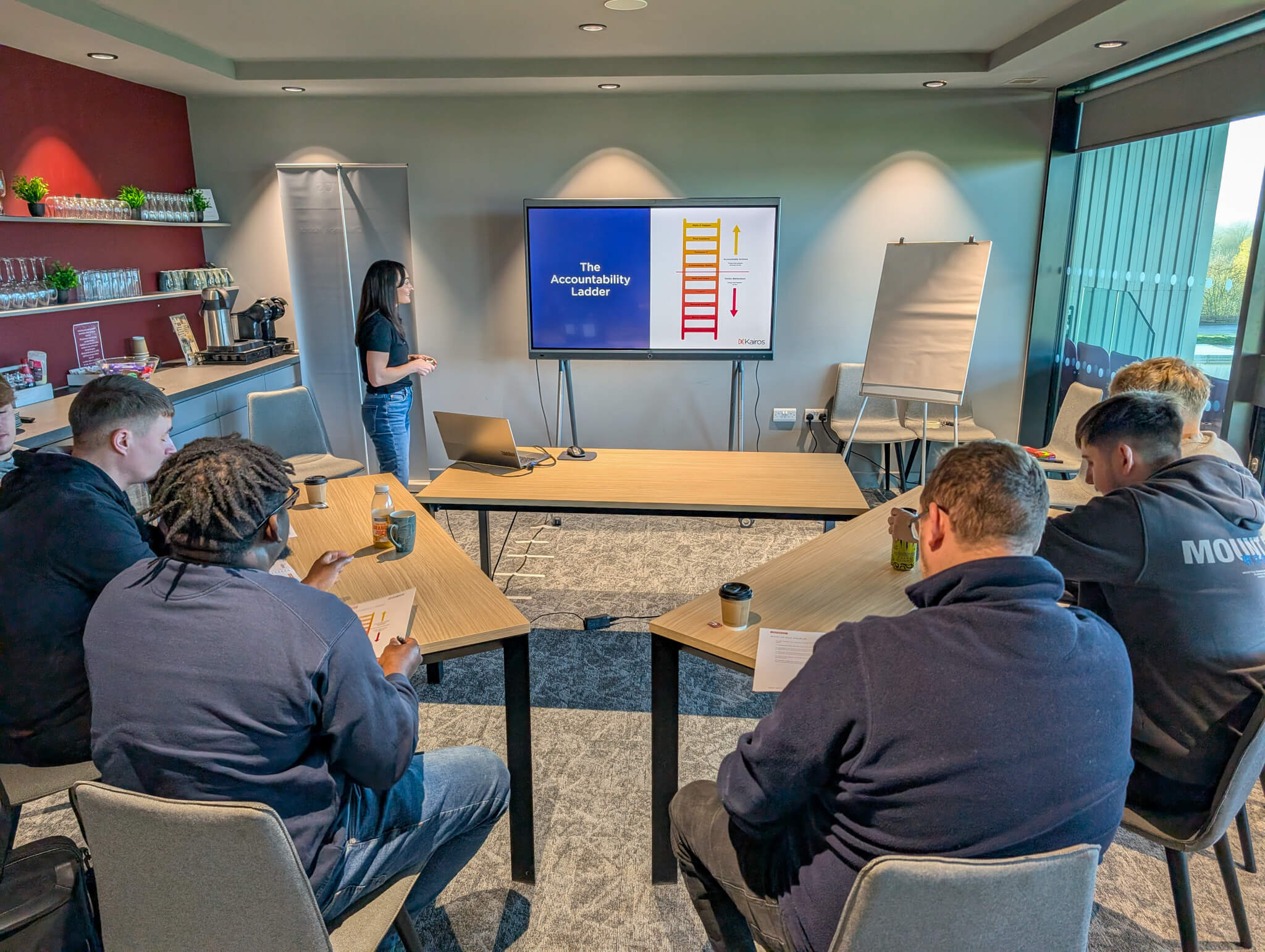
We create a learning environment where people are actively engaged, challenged and required to think.
Because real development doesn’t come from being told what to do. It comes from understanding, applying and choosing to act differently.
Our approach combines different methods where appropriate – including workshops, coaching, one-to-one support, virtual sessions and practical tools – but the focus is always the same:
We place a strong emphasis on experiential learning and coaching-led development.
Experiences bring learning to life in a way slides never can – people don’t just hear it, they experience it. By working through real or simulated situations, behaviour shows up in the room.
That gives us something tangible to work with – something we can challenge, reflect on, and improve.
Instead of talking about what should happen back in the workplace, we explore what actually happens in the moment. This makes the learning more immediate, more relevant, and more likely to translate into real behaviour change.
Alongside this, our coaching-led approach ensures people are both supported and challenged – helping them think more clearly, raise their standards and apply learning in line with the expectations of their role.
This is where many Kairos moments occur – when something clicks, thinking shifts, and behaviour begins to change. Because development is not about delivering content. It’s about helping people see things differently, raise their standards, and act accordingly.
But insight alone is not enough – it needs to be applied consistently in the real world.

4. Embed into day-to-day performance

People leave a session motivated, with good intentions – but without the right environment and support, those intentions fade quickly.
We focus on ensuring that learning translates into consistent behaviour and performance over time. That means recognising that development is not just about the session itself, but what happens afterwards.
We work with organisations to create the conditions that support change:
We also recognise that change is not always linear. People need the opportunity to try new approaches, reflect on what works and learn from what doesn’t.
When supported properly, this process builds confidence, capability, and consistency.
Because lasting development requires more than motivation. It requires an environment that supports and sustains it.

Proof in Performance

Sales Training Leadership Development Culture Change

Results and Impact